Showing posts with label Bilingual Tips. Show all posts

Sustantivos

¿Cómo enseñas acerca de los sustantivos en tu clase? Yo siempre me divierto mucho cuando aprendemos de los sustantivos. Es un tema muy importante pero fácil de entender para la mayoría de los niños. 

To read this post in English click HERE.
Este artículo contiene enlaces de patrocinio. Puedes leer los detalles aquí.

Decidí introducir el tema de los sustantivos con uno de mis libros favoritos, El conejito Knuffle. Es el libro PERFECTO para hablar de los sustantivos porque tiene muchísimos ejemplos. Mientras leíamos dejé que los niños mencionaran los sustantivos que veían. 
Después creamos esta ayuda visual juntos y clasificamos cada sustantivo en la categoría correcta. 
Después los estudiantes regresaron a sus mesas para crear una ayuda visual y pegarla en su cuaderno.
Al día siguiente trabajamos utilizando esta divertida actividad donde los niños pudieron dibujar su propio sustantivo para cada categoría. 
¡Muy sencillo y fácil!

Puedes encontrar la ayuda visual GRATIS AQUÍ.
Puedes encontrar las actividades del cuaderno AQUÍ

¿Qué otras ideas tienes para enseñar acerca de los sustantivos?
2

Sustantivos - Nouns in Spanish

How do you teach about nouns in your classroom? I always have so much fun teaching this skill. It's such an important skill for students to master and it's easy for students to understand.

*Para leer este artículo en español presiona aquí.
This post may contain affiliate links. You can read the full disclosure here


We started by reading one of my favorite books El Conejito Knuffle. Let me tell you, this book is PERFECT to teach nouns for the first time. I allowed students to point out any nouns they found while we read. 
Then we created this easy anchor chart and students sorted each noun in the right category. 
Students went on to color their own anchor chart to include in their journals. 
The next day students used this sheet to draw their own noun for each category. 
Quick, easy, painless! 

You can find the anchor chart pieces HERE for FREE!
You can find the Nouns sheets HERE
0

Palabras de Uso Frecuente


Este artículo contiene enlaces de patrocinio. Puedes leer los detalles aquí.

En mi salón aprender nuestras palabras de uso frecuente es una prioridad. Trabajamos con ellas todos los días. Es muy importante para mí que mis alumnos se sientan emocionados de aprender a leer y reconocer las palabras de uso frecuente. He sido maestra de tercer grado y se lo importante que son estas palabras y lo difícil que es para los estudiantes cuando no pueden leer las palabras en tercer grado. Por eso como maestra de niños más pequeños he decidido que es una prioridad en mi salón. ¡Pero lo mejor de todo es que a mis alumnos les encantan!

Mis alumnos saben lo que son las palabras de uso frecuente pero para divertirnos más las llamamos "Palabras Monstruo". Al principio del año (o cuando mis alumnos estén listos) presento las palabras monstruo con MUCHA emoción. Primero llega a mi salón el monstruo amarillo. Y explico que el monstruo amarillo tiene 10 palabras que ellos tienen que practicar y aprender. Una vez que sepan las 10 palabras del monstruo amarillo, celebraremos!! Mis alumnos reciben un pequeño premio y escribimos su nombre en el monstruo amarillo que tenemos en el pasillo de nuestro salón para que todos se sientan orgullosos de ellos. 
Mis estudiantes practican cuando terminan su trabajo, durante centros de lectura, y practicamos juntos todos los días. 
Una de mis cosas favoritas es ver a los alumnos ayudándose entre ellos mismos sin pedir mi ayuda. Muchas veces los he visto practicar juntos y los niños que están en un nivel más avanzado que sus compañeros los ayudan a pasar de nivel. ¡DOBLE práctica=maestra feliz!
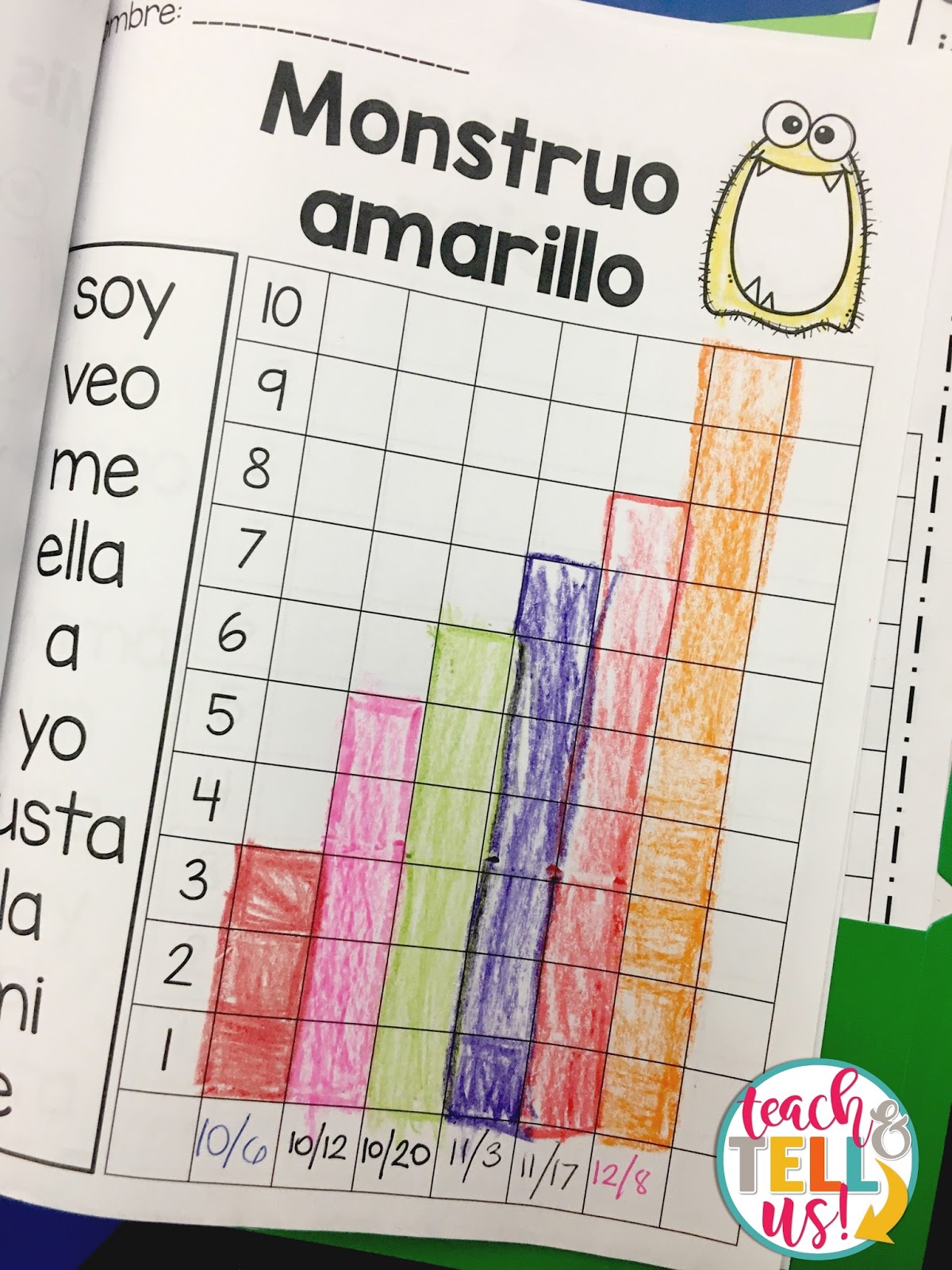
Mis alumnos tienen una carpeta (folder) donde documentan todo su progreso. El folder incluye una hoja de progreso y gráficas para cada monstruo.
Después de cada evaluación, los alumnos colorean el número de palabras correctas en su gráfica. Cuando los alumnos completan la gráfica de un nivel pueden colorear el monstruo correspondiente en su hoja de progreso.
Este folder ha sido una gran ayuda para mostrar a los padres de familia el avance de sus hijos. Ellos fácilmente pueden ver cuanto han avanzado sus hijos desde el principio del año. También es una herramienta excelente para demostrar el avance de tus alumnos durante tu evaluación como maestro(a).

Folders con portada y gráficas


Hojas de progreso


En mi salón celebramos el esfuerzo y progreso de muchas maneras. Cuando un alumno termina un nivel de palabras, ¡toda la clase aplaude y celebra! Escribimos el nombre de ese estudiante en el monstruo que esta en el pasillo y el estudiante recibe un pequeño premio.
Aquí están los premios que utilizamos en nuestra clase:
Monstruo amarillo: lápiz de monstruo
Monstruo rojo: tatuaje temporal de monstruo 
Monstruo azul: juguete de monstruo
Monstruo verde: pelota de monstruo
Monstruo morado: paleta de monstruo
Monstruo café: juguete de monstruo 
Monstruo anaranjado: juguete de monstruo
Monstruo azul fuerte: pato monstruo
Monstruo gris: monstruo de peluche
Monstruo rosa: vaso de monstruo

Estos son los monstruos que utilizamos afuera del salón y escribimos el nombre de los niños cuando pasan a un nivel nuevo de palabras.

En mi salón utilizamos tarjetas para practicar en arillos como estos. Simplemente plastifico las tarjetas, las perforo y las coloco en un anillo. Yo tengo 4 arillos de cada color de palabras (especialmente de los primeros dos niveles). Así aseguro que tengamos suficientes para los alumnos que quieran practicar. 
También utilizo estas listas de palabras. Estas listas las llevan los alumnos a su casa para practicar con su familia. 


Cada clase y cada alumno es diferente. Lo mejor de este 
programa de palabras es que lo puedes adaptar a tus necesidades. Durante algunos años escolares mis alumnos necesitan retos más difíciles porque la mayoría están listos para ellos. Otros años mis alumnos toman más tiempo en cada lista de palabras. Pero eso no me preocupa. Siempre y cuando mis alumnos avancen semana tras semana yo soy feliz!
La rúbrica para determinar si tus alumnos están listos o no para el siguiente nivel depende de ti y tus expectativas completamente.  
En mi salón los alumnos pasan de nivel cuando puedan leer las 10 palabras con fluidez (menos de dos segundos por palabra). 
He tenido estudiantes que necesitan un reto más grande. Para ellos ajusto el programa y para pasar de nivel deben de escribir las palabras correctamente. 
No siempre. Como lo mencioné anteriormente, todas las clases son diferentes. Algunas clases ya tienen la capacidad de aprender todas las listas. Otras no, pero ese no es problema! Solo utilizo las listas que considero apropiadas para mis alumnos. 

Si tienes alguna pregunta en como utilizar las palabras monstruo no dudes en contactarme! 
¡Lo más importante es que tus alumnos estén emocionados y motivados para aprender todas las palabras de uso frecuente!


0

Bilingual Tips: Sentence Stems

Hello friends! I'm so happy to be back with more tips for your bilingual/ESL/ELL students! Remember these tips will be extremely helpful even if you aren't a bilingual teacher. 

So today let's talk about sentence stems. If you aren't using them in your classroom yet let me just tell you these are a MUST if you have ELLs in your classroom. 

Why should I use sentence stems in my classroom?

1. Confidence
We teachers are constantly looking for ways to build up our students' confidence and putting in all our effort to make it happen. If you're a bilingual teacher or have an ESL student in your classroom you gotta double that effort! 
I have found that many ELLs are able to give you the correct answer but they lack communication skills...after all, they're learning a new language! Giving them sentence stems as a resource to refer back to will boost their confidence and you will get them talking in no time!! 

2. Complete sentences
This is hands down one of my biggest pet peeves (and believe me, I have many). I'm always encouraging my students to speak using complete sentences. It is very easy for ELLs to find a place where they feel comfortable and this keeps them from learning new vocabulary. Sentence stems will build their vocabulary AND they will get used to speaking in complete sentences. 

3. Ownership
Once you promote that use of sentence stems in your classroom every day students will take ownership of those new words. Believe me! It will come so natural to them that they won't even notice that magic moment when they started using new words. 

I like to go simple, quick, and pain-free with my sentence stems. Most of the time I just grab a sentence strip and write it ahead of time if I know it's something I will be using that day. But let's face it...most of our teachable moments happen right there when you aren't prepared for it. So I quickly grab a sentence strip and write it right there on the spot! 


Your ELLs a little extra help! Don't make them start their sentences from scratch if they're not ready yet! 
Do you use sentence stems in your classroom? How do you use them?


0

Back to the BasicsI


I remember my first year teaching, it still comes back and hunts me sometimes. I was teaching a third grade bilingual class. When students came in, I was so nervous about getting them started that I forgot they "might" not speak any English. I kept going on and on and on about procedures, rules and expectations. Everyone was quiet...all 22 of them. I kept thinking to myself they were the most wonderful students I could ever ask for (and they were) how awesome was it that my students are paying such close attention to me!! Until one little girl raised her hand and asked (in Spanish): Could you please repeat everything you just said but in Spanish? 
Source: The Cornerstone

BAM! I felt horrible! These kids weren't fluent in the language and there I was ASSUMING they understood everything I had just said. So of course, I quickly adjusted and repeated every single thing. 

Assuming our kids know a certain skill or have a particular habit because "they should have learned it in the previous year" is one of the WORST MISTAKES we can do as teachers. 

It was very unfortunate to realize that even though many of these kids weren't newcomers they still needed instruction as if they were. 

If you ever find yourself in the same situation I was in just keep in mind that the best you could possibly do for your kiddos if to GO BACK TO THE BASICS!

For me that meant teaching the parts of the body, names of animals, farm animals. I even taught some of them how to say: Hello! My name is ________. I vividly remember playing a video and singing  just like a kindergartener teacher: head, shoulders, knees and toes, KNEES AND TOES!  

Was it ideal? NO. Was it something I was supposed to be teaching in third grade? NO. I so wish they would have had all that vocabulary before getting to third grade but they didn't. Someone had to teach it. I was definitely not going to let those kids go on to the next grade without having that basic vocabulary. 

Here's some ideas of basic vocabulary/resources your bilingual students might need: 


If you ever find that your students haven't learned a skill that was meant to be learned in a prior year, TEACH THEM! Please, please, please DO NOT ignore it! 


0

Cognates


Do you know what cognates are? Do you use them in your classroom? If you have ELLs in your classroom (even if you're not a bilingual teacher) you should be using them!! Or maybe you are a Dual Language teacher and have students learning Spanish? Use cognates!! 
For some strange reason my students adore that little word and we talk about it EVERY SINGLE DAY in our classroom.
If you were to come into my classroom and ask one of my students what cognates are, they would simply say: words that sound about the same in English or Spanish and share a similar meaning. That's it! Pretty easy to understand...right?

Let's see some examples from the Cognates Wall in my classroom:
Some cognates are spelled the same in English and Spanish, some others aren't and that's ok. Like I tell my kids: as long as they sound close to another word and they remind you of a word in Spanish.

Why should I use cognates in my classroom?

Cognates are a super powerful strategy to use with ELLs. They are able to make a connection between the two languages and build their comprehension. 
Every time we are getting ready to read a new text, I immediately ask my students to look for cognates and underline them. 

Other times, while my students and I are talking, a cognate will come up. I usually say very quickly and excited: THAT'S A COGNATE!! Eventually, the kids start telling me when they find one and it becomes an exciting little game!

WATCH OUT FOR FALSE COGNATES!!
Unfortunately there are some words that appear to be cognates but they aren't. Remember that cognates have a similar sound and definition. Some words sound the same in English and Spanish but they DO NOT share the same definition. 
For example: the word embarrassed is usually misused by bilingual students because it sounds similar to "embarazada" in Spanish which means pregnant! We certainly don't want our kids misusing that word lol! 
The word carpet in English is similar to "carpeta" in Spanish. However, "carpeta" means folder. 
If you are going to teach cognates to your kids, you gotta watch out for these tricky words. Remember, when in doubt, just Google it! If you tell your students about false cognates they will be aware and understand not all words are cognates! And let me tell you... they will LOVE to find those false cognates.

Here is a link to my favorite list of cognates. (By the way Colorin Colorado is an amazing website with very helpful articles on teaching ELLs). I use this list every day! Remember to talk to your students about false cognates, they will learn to recognize them faster than you think! 


0
Powered by Blogger.
Back to Top